

Home charger and your own solar
EV charger installation Charge at home. Without tripping the fuse.
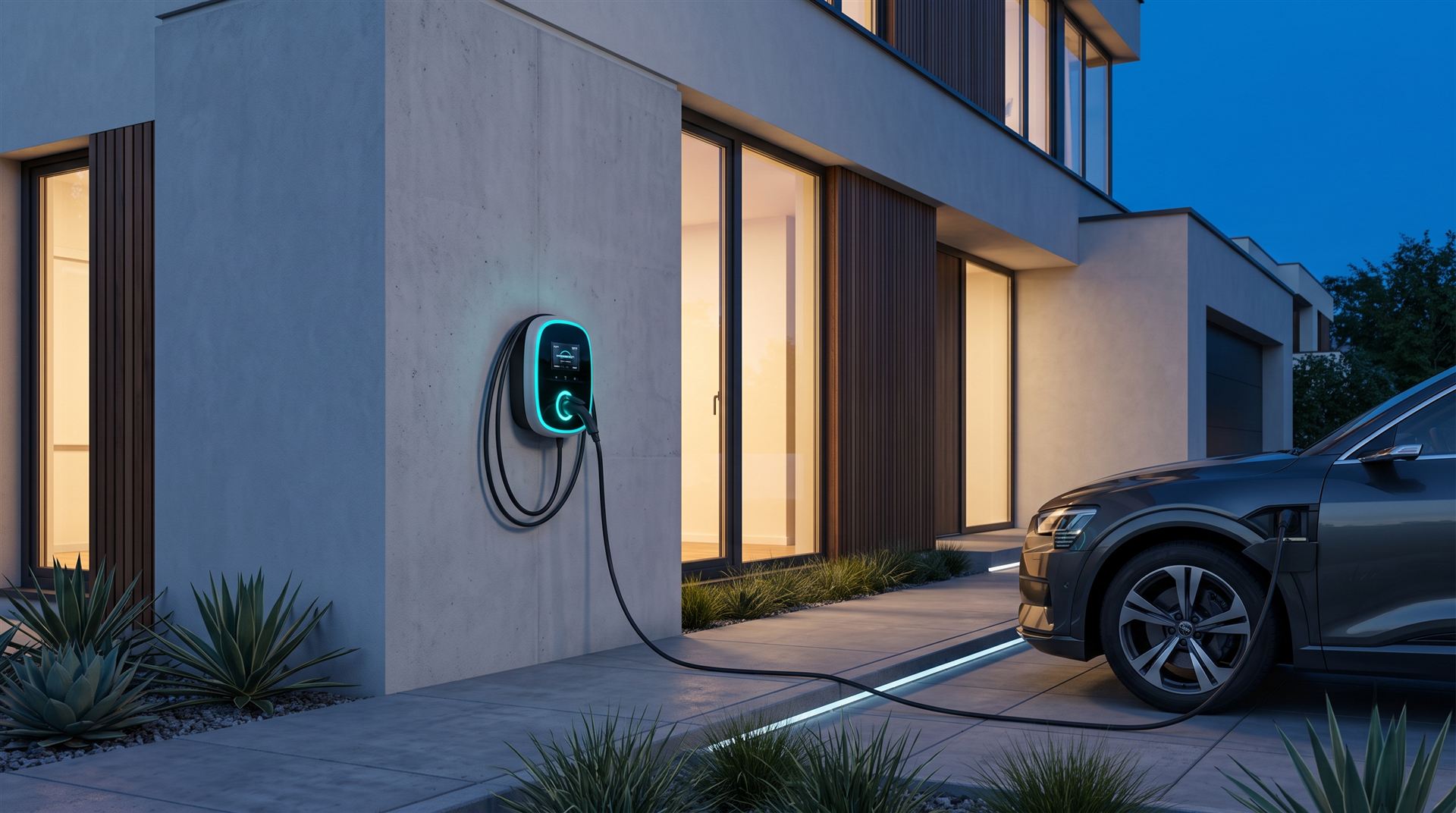
Home and business chargers of 7.4, 11 and 22 kW with smart load management. Charge at night on the low tariff or from your own solar surplus — and we make sure your wiring can safely handle it.
- Overload protection (DLM)
- Charging from solar surplus
- RFID for rentals and businesses
In short: we install smart EV chargers of 7.4, 11 and 22 kW with dynamic load management (DLM) for homes, holiday rentals and businesses across Croatia. DLM prevents the main fuse from tripping, so buying extra grid capacity is usually not needed. An 11 kW charger adds about 65 km of range per hour, and charging at home on the low tariff costs about €1.50 per 100 km — compared with about €9.50 at public fast chargers.
Smart charging
Why a smart charger and not a regular socket?
Charging a car takes hours and loads your wiring more than any household appliance. When the water heater, oven or air conditioning come on as well, an ordinary charger trips the main fuse — or worse, overheats the wiring over time.
A smart charger with dynamic load management (DLM) constantly measures the house's consumption and reduces charging power when needed. The car is still fully charged overnight, and a costly connection upgrade is usually unnecessary.
- Correct protection and cable size for your distance from the fuse box
- Charging at night on the low tariff or from solar surplus
- RFID cards and an app for guests, staff and fleets
- Testing and certificate after installation
about 65 kmof range per hour of charging on an 11 kW charger
EV configurator
Five clicks to the right charger.
Answer five questions and instantly see the recommended power, charging speed, a connection check and annual savings.
Charging cost
What 100 km costs.
Driving cost compared for about 15,000 km a year.
| Charging | Cost per 100 km | Per year, about 15,000 km |
|---|---|---|
| At home, on solar surplus | about €0.60 | about €90 |
| At home, low tariff | about €1.50 | about €230 |
| Public fast chargers | about €9.50 | about €1,430 |
| Petrol / diesel | about €10.50 | about €1,580 |
Indicative figures. An 11 kW charger adds about 65 km of range per hour and a 7.4 kW charger about 44 km — most EVs charge at up to 11 kW at home.
Cost of driving
What does 100 km cost?
An approximate comparison for an average electric car.
Home charger on the low tariff
Public fast chargers
Petrol or diesel
Family homes
A charger in the garage or on the facade, with DLM protection and the option to charge on solar.
Rentals and holiday homes
A guest charger as a listing advantage, with RFID access and the option to bill for charging.
Businesses and fleets
Several charging points, power sharing and per-vehicle consumption tracking.
FAQ
Questions about chargers.
Do I need to buy extra connection capacity for a charger?
Usually not. A smart charger with dynamic load management (DLM) reduces its power when other large appliances are on, so the main fuse does not trip.
Which charger power should I choose?
For most houses with a three-phase connection an 11 kW charger is optimal, since most electric cars charge on AC up to that power. For a single-phase connection we recommend 7.4 kW with DLM.
Can the car charge from solar surplus?
Yes. A smart charger can charge the car only from surplus solar production, so you drive on your own sunshine.
Is a charger worth it for holiday rentals?
Guests with electric cars increasingly filter accommodation by charger. With RFID or an app you can also charge them for charging.
How long does installation take?
A standard installation in a garage or on a wall up to 5 metres from the fuse box is usually done in one day. Longer cable runs and pedestals take more time.