

Smaller house
Bill of about €100 a month
Plant4.7 kWp
Savings€690
- Price
- about €5,140
- With subsidy
- about €2,570
- Payback
- about 7 years
- With subsidy
- about 4 years
We design, obtain approvals for, install and commission solar plants for family homes — at a fixed price and with the subsidy application included. You just watch production in the app.
In short: we design and install solar plants for family homes across Croatia — with or without a battery. For a home with a bill of about €150 a month this is typically about 7 kWp (15 panels) for about €6,530 at 0 % VAT, or about €3,260 with the usual 50 % subsidy, saving about €1,030 a year with a payback of about 6 years (about 3 with the subsidy). We handle the design, application and the whole grid procedure for you.
Your electricity bill does not depend on you — it depends on prices, network fees and decisions you have no say in. Your own solar plant puts part of that bill back in your hands: power produced during the day is used directly in the house, and the surplus goes to the grid.
A well-sized plant is not the biggest one, but the one that matches your consumption. So we size it to your household's actual consumption, roof orientation and the sunshine in your county — without the oversizing that, under net billing, only lengthens the payback.
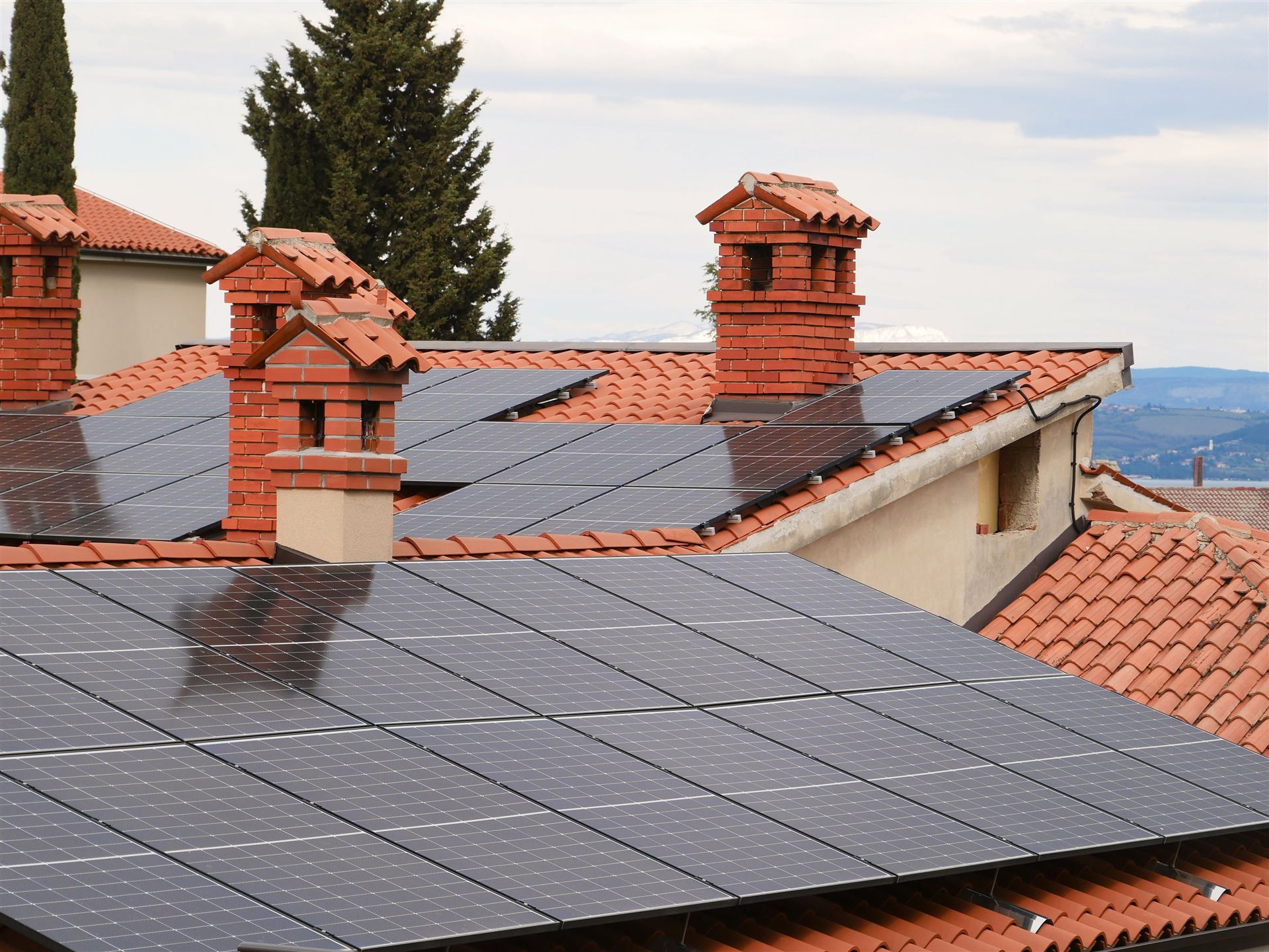
Six short questions. At the end you see the plant size, estimated price with and without the subsidy, annual savings and payback — for panels only and with a battery.
Estimates from our calculator for a south-facing roof in Split-Dalmatia County, panels only. Your result depends on location, roof and consumption.
Savings shown per year. Prices with 0 % VAT. The subsidy is an estimate and depends on the terms of the public call.
Indicative figures for a south-facing roof in Split-Dalmatia County, at 0 % VAT and with panels of about 465 W. Click your size to get the exact figure for your roof.
| Plant size | Indicative price (0 % VAT) | With subsidy | Panels and roof | Annual production | For a monthly bill of about | Indicative annual savings | Your roof |
|---|---|---|---|---|---|---|---|
| 4 kW | about €4,880 | about €2,440 | 9 panels · 20 m² | about 6,100 kWh | €95 | about €620 | Estimate → |
| 5 kW | about €5,400 | about €2,700 | 11 panels · 25 m² | about 7,400 kWh | €115 | about €760 | Estimate → |
| 6 kW | about €5,910 | about €2,960 | 13 panels · 30 m² | about 8,800 kWh | €135 | about €890 | Estimate → |
| 7 kW | about €6,530 | about €3,260 | 15 panels · 35 m² | about 10,100 kWh | €155 | about €1,030 | Estimate → |
| 8 kW | about €7,360 | about €3,680 | 17 panels · 40 m² | about 11,500 kWh | €175 | about €1,170 | Estimate → |
| 9 kW | about €7,880 | about €3,940 | 19 panels · 45 m² | about 12,800 kWh | €195 | about €1,310 | Estimate → |
| 10 kW | about €8,780 | about €4,390 | 22 panels · 50 m² | about 14,800 kWh | €225 | about €1,510 | Estimate → |
| 11 kW | about €9,300 | about €4,650 | 24 panels · 55 m² | about 16,200 kWh | €250 | about €1,650 | Estimate → |
| 12 kW | about €10,860 | about €5,430 | 26 panels · 60 m² | about 17,500 kWh | €270 | about €1,790 | Estimate → |
| 13 kW | about €11,380 | about €5,690 | 28 panels · 65 m² | about 18,900 kWh | €290 | about €1,930 | Estimate → |
| 15 kW | about €13,080 | about €7,080 | 32 panels · 75 m² | about 21,600 kWh | €330 | about €2,200 | Estimate → |
| 17 kW | about €15,020 | about €9,020 | 37 panels · 85 m² | about 24,900 kWh | €380 | about €2,540 | Estimate → |
| 18 kW | about €15,540 | about €9,540 | 39 panels · 90 m² | about 26,300 kWh | €400 | about €2,680 | Estimate → |
| 19 kW | about €16,060 | about €10,060 | 41 panels · 95 m² | about 27,600 kWh | €425 | about €2,820 | Estimate → |
| 20 kW | about €16,730 | about €10,730 | 43 panels · 95 m² | about 29,000 kWh | €445 | about €2,960 | Estimate → |
Prices are indicative and not an offer. The Fund's subsidy covers up to 50 %, but no more than €600 per kW and €6,000 per plant, so its share falls for larger plants; the final amount depends on the open public call. Savings assume you use about a third of the electricity directly at home and export the rest to the grid. For businesses see solar plants from 30 to 500 kW.
Why do two houses with the same 8 kW plant save different amounts? Because a table can't see your daily consumption pattern, your roof's orientation or the shadow of a chimney. Size a plant for your own roof in one minute →
For smaller homes with a bill of about €90 to €140 a month. They fit on 20 to 30 m² of roof. On a single-phase connection no more than 3.68 kW may be exported to the grid, so we check your connection before making an offer.
The most common choice for a family house with air conditioning, a water heater or a pool and a bill of about €150 to €230 a month. They need about 35 to 50 m² of roof and a three-phase connection. At this size the subsidy usually covers the full 50 % of the price.
Plants of 11, 12, 13 and 15 kW suit larger homes with a heat pump or an electric car, and 17, 18, 19 and 20 kW suit houses with holiday apartments and villas with pools. They need 55 to 95 m² of roof, and at this size we always check the property's connection capacity.
Rotate the house with your mouse or finger and switch between day, evening and night. This is how a plant with a battery and smart control works.
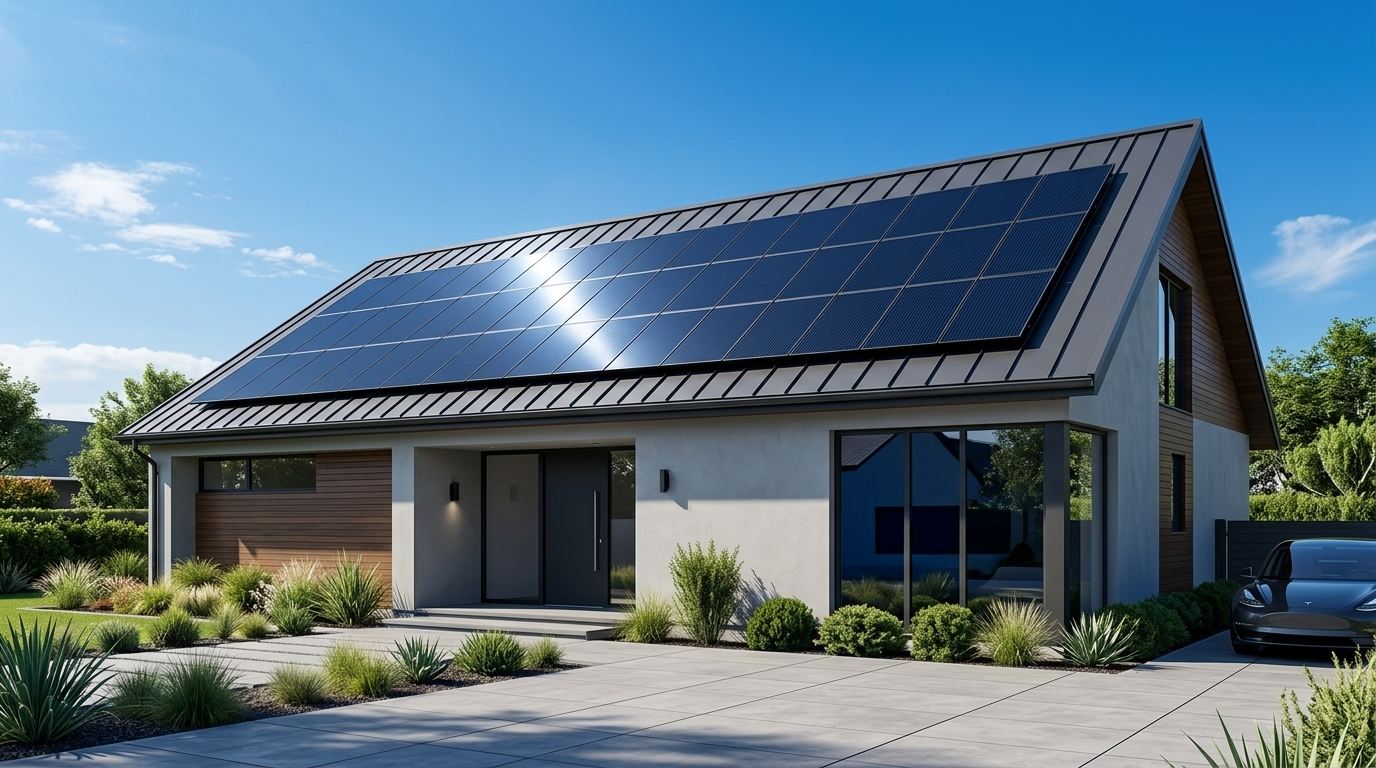
Panels power the house and charge the battery and car. Only what you don’t use goes to the grid.
After sunset the house runs on energy stored during the day — exactly when grid power costs the most.
A smart system can top up the battery and car from the grid at night, on the cheaper tariff, and use that energy in the morning instead of pricier daytime power. Especially useful in winter, when there is less sun.
We take full responsibility for the engineering and the months-long procedures with the grid operator. You get a finished plant and one contact for every question.
Main electrical design digitally signed by a licensed engineer.
The complete procedure with the grid operator up to approval.
Installed to the design and manufacturer’s instructions, mounts tightened with a torque wrench to the specified force.
Electrical measurements and a 60-minute trial run.
Certificates and declarations to the grid operator and coordination of the bidirectional meter.
Mobile app setup and a customer folder with all documentation.
Manufacturer's product warranty.
Guaranteed panel output power.
Inverter manufacturer's warranty.
On Brant Energy's mounting and electrical work.
| On-grid | Hybrid with battery | Off-grid | |
|---|---|---|---|
| For whom | Most homes with a grid connection | Those who want more independence and backup | Sites without a grid connection |
| Surplus power | Goes to the grid | Charges the battery, the rest to the grid | Charges the battery |
| During a power cut | Switches off | With backup power | Runs independently |
| Investment | Lowest | Medium | Depends on consumption |
| Payback | Shortest | Longer | Compared with a generator |
Supply and installation of solar panels on residential buildings in Croatia is subject to 0 % VAT. In addition, the Environmental Protection and Energy Efficiency Fund periodically opens public calls for households, usually covering up to half of the eligible costs of the plant and battery.
That is why the calculator shows price and payback with and without the subsidy. When a call is open, we prepare the documents and guide you through the application.
Subsidy, 0 % VAT and green loansWe size the plant to your consumption, not to the floor area of the house. The goal is to cover as much consumption as possible without unnecessary surplus. The calculator gives a first estimate and we confirm the exact size after reviewing the roof.
The plant works on an east or west roof too, with somewhat lower production than on a south roof. The calculator takes this into account when you choose the roof orientation.
It depends on the plant size. You enter the approximate usable area in the calculator and we make sure the proposal fits on the roof. Chimneys, skylights and shade reduce the usable area.
Croatia's Environmental Protection and Energy Efficiency Fund periodically opens public calls for households, usually covering up to half of eligible costs. We follow the calls and guide you through the application.
Yes, if the system supports it. A smart hybrid system tops up the battery from the grid at night on the cheaper tariff and uses that energy in the morning instead of pricier daytime power. This is especially useful in winter, when panels produce less. We set it up to match your tariff.
Power you do not use goes to the grid and is settled under net-billing rules. A battery stores part of the surplus for the evening and night, so you buy less power from the grid.
Very little. We recommend an occasional visual check and monitoring production in the app; any drop in output is visible immediately.
Send your estimate or an enquiry — an engineer replies within 24 hours with a proposal for your roof.